
Who's the Best for RIS/PACS Integration: Intelerad vs Medicai
Hospitals and imaging centers choosing between Intelerad and Medicai must decide which platform actually connects their RIS to PACS without forcing staff to maintain two separate logins and manual data transfers.
This article walks through the concrete differences in cloud infrastructure, API access, and multi-location support so you can pick the system that fits your existing workflow and compliance needs. By the end you will know exactly which vendor matches your volume, your vendor stack, and your budget.
Quick Verdict: Medicai vs Intelerad for RIS/PACS Integration
Medicai's cloud-native platform processes over 1 million studies annually with 50 million yearly API transactions, positioning it as a modern alternative to Intelerad's established on-premise and cloud offerings.
Three decision factors separate these platforms for radiology information system and picture archiving communication system needs. Medicai demonstrates proven scalability through 1 million annual studies and 50 million API transactions, while Intelerad relies on traditional deployment models that may require additional setup time.
Security compliance represents another key difference. Medicai maintains HIPAA and GDPR compliance alongside FDA clearance for its viewers, following OWASP security guidelines. Intelerad emphasizes enterprise customization rather than standardized compliance certifications.
Pricing structures further distinguish the solutions. Medicai offers a monthly subscription starting at $249, providing predictable costs for growing practices. Intelerad uses variable licensing models that may complicate budgeting for smaller radiology departments.
These factors favor Medicai for organizations seeking cloud deployment with transparent costs and verified compliance standards.
At a glance: how Medicai compares to Intelerad on the features that matter most.
| Feature | Medicai | Intelerad |
|---|---|---|
| RIS/PACS Integration | ✓ | ✓ |
What Is Medicai?
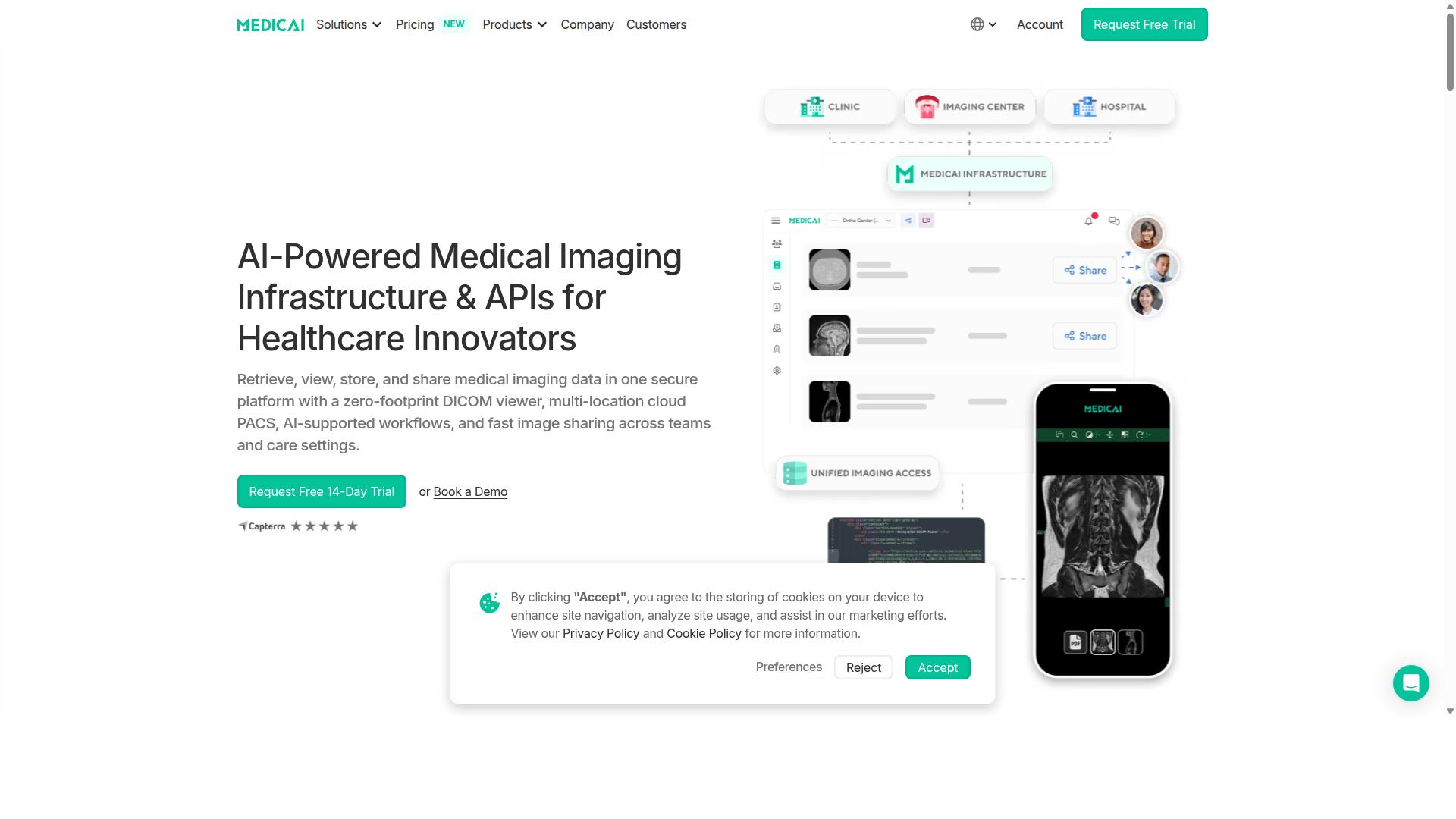
Medicai operates as a cloud-based medical imaging platform that retrieves, views, stores, and shares imaging data through a zero-footprint DICOM viewer.
The platform brings together four primary service areas that work together as one secure system. CONNECT & RETRIEVE features include the Medical Imaging Uploader and DICOM Gateway. STORE & MANAGE capabilities cover Cloud PACS, Medical Image Exchange, Patient Case Management, Vendor Neutral Archive, and Backup and Disaster Recovery.
Users gain ACCESS & VIEW through a zero-footprint DICOM viewer along with additional tools such as Structured Reporting for Radiology, Doctor Imaging Portal, Patient Imaging Portal, Medicai Imaging API, and Mobile Imaging App. The platform also provides SHARE & COLLABORATE functions that support Tumor Boards and teleradiology workflows.
These components connect into a single environment that handles medical imaging from upload through final reporting. The system supports radiology departments looking for integrated solutions that address both storage needs and collaboration requirements.
What Is Intelerad?

Intelerad provides radiology information system and picture archiving communication system solutions that combine RIS and PACS functionality for hospital and imaging center workflows.
Its enterprise approach supports on-premise and cloud deployment options depending on institutional needs. Large healthcare systems use these options to manage complex radiology operations across multiple sites.
Organizations often select Intelerad for its presence in hospital environments and its ability to handle high-volume imaging requirements. The platform allows workflow customization that aligns with internal processes of major health networks.
Interoperability remains a key consideration when comparing vendors. Systems that support DICOM and HL7 standards improve image management across different departments and facilities.
Scalability and security compliance, including HIPAA requirements, influence vendor selection for many institutions. Implementation timelines and training resources also affect how quickly teams achieve full system adoption.
Features Compared
Three critical feature categories determine RIS/PACS integration success: cloud deployment flexibility, API connectivity for automation, and security compliance standards.
Each platform approaches these areas differently, with distinct pricing structures and technical capabilities affecting healthcare organizations.
Understanding these differences helps medical facilities select the right solution for their workflow requirements and budget constraints.
Cloud PACS & Multi-Location Integration
Medicai's Standard plan at $749/month includes one connected location with 2 TB storage, while additional locations require separate Standard subscriptions.
Enterprise customers can access custom pricing for multiple connected locations and external sites, supporting scalable growth across healthcare networks.
Intelerad typically follows an enterprise multi-site deployment model with pricing structures suited for large hospital systems and established medical groups.
Both platforms address bandwidth optimization during data transfers between locations, though deployment approaches vary based on infrastructure needs.
Medicai's tiered pricing model allows smaller practices to start with the Starter plan at $249/month before scaling to multi-location setups as patient volume increases.
API & Workflow Automation
Medicai processes 50 million API transactions yearly, enabling direct integration with third-party systems through HL7 and DICOM protocols.
This API-first approach supports automated workflows between radiology information systems and picture archiving communication systems without manual data entry.
Intelerad offers enterprise integration capabilities that connect with existing hospital infrastructure and third-party applications through standard healthcare protocols.
Medicai's 50 million yearly transactions demonstrate the platform's capacity for high-volume data exchange across multiple healthcare facilities and external partners.
Both solutions facilitate RIS/PACS data exchange, though Medicai's documented transaction volume provides measurable evidence of API reliability at scale.
Security & Compliance
Medicai maintains HIPAA and GDPR compliance with FDA and CEE regulatory clearances for its DICOM viewer technology.
The platform follows OWASP security guidelines to protect medical imaging data throughout storage and transmission processes.
Intelerad implements established enterprise security protocols designed for healthcare environments with strict regulatory requirements.
Both platforms prioritize patient data protection, with Medicai's compliance certifications providing documented adherence to international healthcare security standards.
Healthcare organizations can evaluate each vendor's security architecture based on specific regulatory needs and institutional policies.
Pricing Compared
Medicai offers transparent monthly billing with Starter at $249/month for 500 GB storage and unlimited users, and Standard at $749/month for 2 TB storage with one connected location. These tiers provide clear options for radiology practices seeking predictable costs without complex negotiations.
Intelerad typically uses enterprise licensing models that vary based on facility size and customization needs. Implementation timelines often extend longer due to on-premise deployment requirements and facility-specific configurations.
Storage capacity in Medicai scales across defined tiers. The Starter plan includes 500 GB cloud storage while Standard expands to 2 TB. Enterprise options allow custom storage volumes for larger operations.
User accounts remain unlimited across all Medicai pricing levels. This structure supports growing teams without additional per-seat costs that often appear in enterprise agreements.
Connected location counts differ by subscription tier. Starter offers no connected locations while Standard includes one. Enterprise plans accommodate multiple connected locations plus external site connections.
One-time setup fees apply for DICOM Gateway installation at $1,000 per location. This cost covers initial connectivity configuration for each site.
Yearly billing provides 15 percent savings over monthly rates. Starter drops to $209/month and Standard to $639/month when paid annually. Enterprise pricing stays custom regardless of billing cycle.
Per-study pricing remains available for enterprise customers who prefer usage-based models. This flexibility accommodates varying patient volumes and operational requirements.
Free 14-day trials of Starter features require no credit card for signup. Organizations can evaluate core functionality before committing to paid plans.
Who Should Choose Medicai
Healthcare providers managing 500 GB to 2 TB of monthly imaging volume who need transparent pricing and rapid cloud deployment will find Medicai's structure advantageous. Specialty care practices such as orthopedics, neurology, oncology, radiology, and cardiology often operate within this volume range. These groups benefit from avoiding enterprise licensing contracts in favor of monthly billing.
Imaging centers processing under 1 million studies annually represent another strong fit. These facilities frequently require zero-footprint DICOM viewing without investing in heavy on-premise infrastructure. Medicai delivers cloud deployment that eliminates the complexity of traditional server setups.
Many specialty providers already use separate RIS and PACS systems. The challenge lies in creating interoperability between these tools without extensive customization. Medicai addresses this need through its integration capabilities with existing radiology information system and picture archiving communication system workflows.
Providers who prioritize security compliance with HIPAA requirements gain additional reassurance from Medicai's architecture. The system supports data migration from existing installations while maintaining regulatory standards. This matters particularly for organizations handling sensitive patient imaging across multiple specialties.
Virtual care providers and telemedicine platforms also align with Medicai's target profile. These organizations need reliable image management that integrates with their existing workflows. The monthly pricing model offers predictability that enterprise contracts often lack.
Who Should Choose Intelerad
Large hospital systems requiring extensive workflow customization and on-premise deployment options typically evaluate Intelerad's enterprise RIS/PACS capabilities. These organizations often maintain complex technology infrastructures that demand specific modifications to match established processes.
Health systems with mature vendor relationships may prefer platforms that support deep EHR integration across multiple departments and facilities. The ability to configure custom reporting workflows helps maintain consistency when handling high volumes of imaging studies.
Established vendor partnerships provide access to dedicated implementation teams familiar with hospital IT requirements. Radiology information system customization often requires coordination with existing clinical applications and security protocols.
Organizations managing on-premise infrastructure may benefit from platforms designed for controlled data environments. Picture archiving systems with flexible deployment models allow hospitals to maintain compliance standards while adapting to unique operational needs.
Facilities prioritizing extensive configuration capabilities often find value in enterprise solutions that accommodate specialized imaging workflows. Integration requirements for large health systems frequently involve multiple data formats and legacy system connections.
Final Verdict
Medicai's combination of 1M+ annual studies processed, 50M+ API transactions, and transparent pricing from $249/month positions it as the stronger choice for cloud-first healthcare providers.
The platform maintains 1.7M+ studies in storage with 300k+ DICOM visualizations delivered to users worldwide. This scale supports practices that require reliable access across multiple locations without managing physical servers.
Organizations can reach implementation teams through two offices. The US location operates from St. Petersburg, Florida while the Romania headquarters handles technical coordination from Bucharest. Both locations provide direct contact for deployment discussions and customization needs.
Modern radiology departments need systems that handle increasing study volumes while maintaining quick access for radiologists and referring physicians. The combination of storage capacity, visualization performance, and accessible support channels gives Medicai an edge over traditional approaches that require extensive on-premise infrastructure.
Intelerad solutions often rely on established but complex deployment models that can extend implementation timelines. Practices seeking faster deployment and lower upfront costs benefit from starting with cloud-native options that scale according to actual usage patterns rather than projected capacity needs.
Recommended Resources: