
Who's the Best for Mobile Access: PostDICOM vs Medicai
Many radiologists still lose time switching between desktop stations and phone screens when checking studies on the go. PostDICOM and Medicai both promise mobile access, yet their zero-footprint viewers and cloud storage models differ in concrete ways.
By the end of this article you will see which platform keeps image transfer under three clicks on any phone, which one supports multi-location teams without extra log-ins, and which pricing tier best fits a small imaging center versus a hospital network.
Quick Verdict: Medicai Leads in Mobile Access
Medicai edges ahead for mobile medical imaging workflows with its zero-footprint viewer and real-time DICOM access on iOS and Android.
- Zero-footprint viewer eliminates local installs, so physicians open studies instantly without software downloads or IT setup.
- 300k+ DICOM visualizations prove mobile reliability across different network conditions and device types.
- HIPAA and GDPR compliance covers data security in transit for every study accessed on phones or tablets.
PostDICOM offers mobile access with traditional client installations. These require device setup and ongoing maintenance across user fleets.
Medicai's approach removes those friction points. Clinicians can review scans immediately, even when they are away from their primary workstation.
Organizations already benefit from the platform's 1M+ studies processed yearly. That volume shows consistent uptime and dependable performance on mobile devices.
At a glance: how Medicai compares to PostDICOM on the features that matter most.
| Feature | Medicai | PostDICOM |
|---|---|---|
| Mobile Access | ✓ | ✓ |
What Is Medicai?
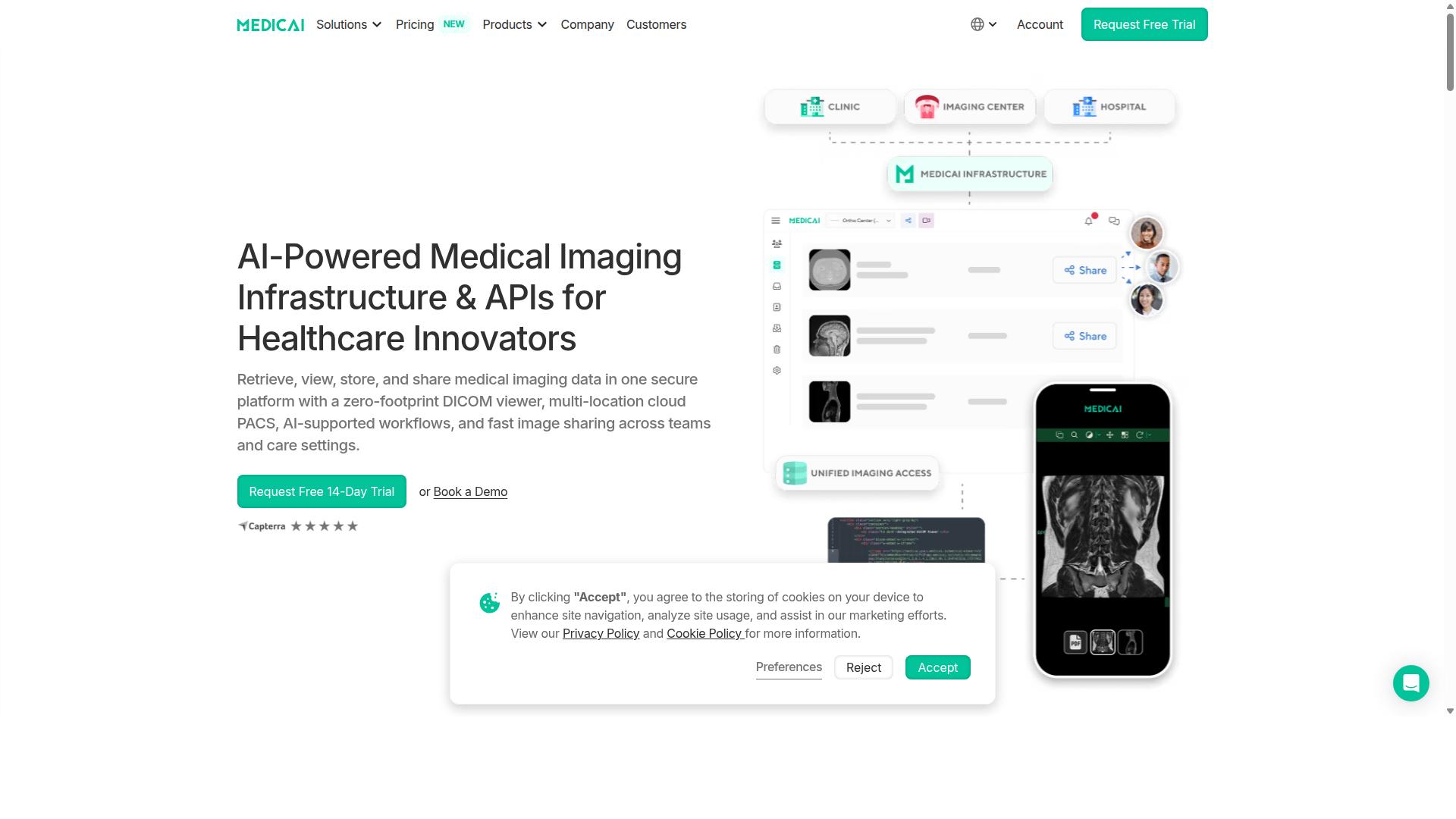
Medicai is a cloud-based medical imaging platform that enables providers to retrieve, view, store, and share imaging data in a single secure environment.
The platform includes a zero-footprint DICOM viewer that runs in any modern browser without local software installation. This approach supports remote radiology workflows across different care settings.
Medicai maintains HIPAA and GDPR compliance with FDA and CEE clearances for clinical use. These certifications address regulatory requirements for medical imaging across multiple jurisdictions.
What Is PostDICOM?
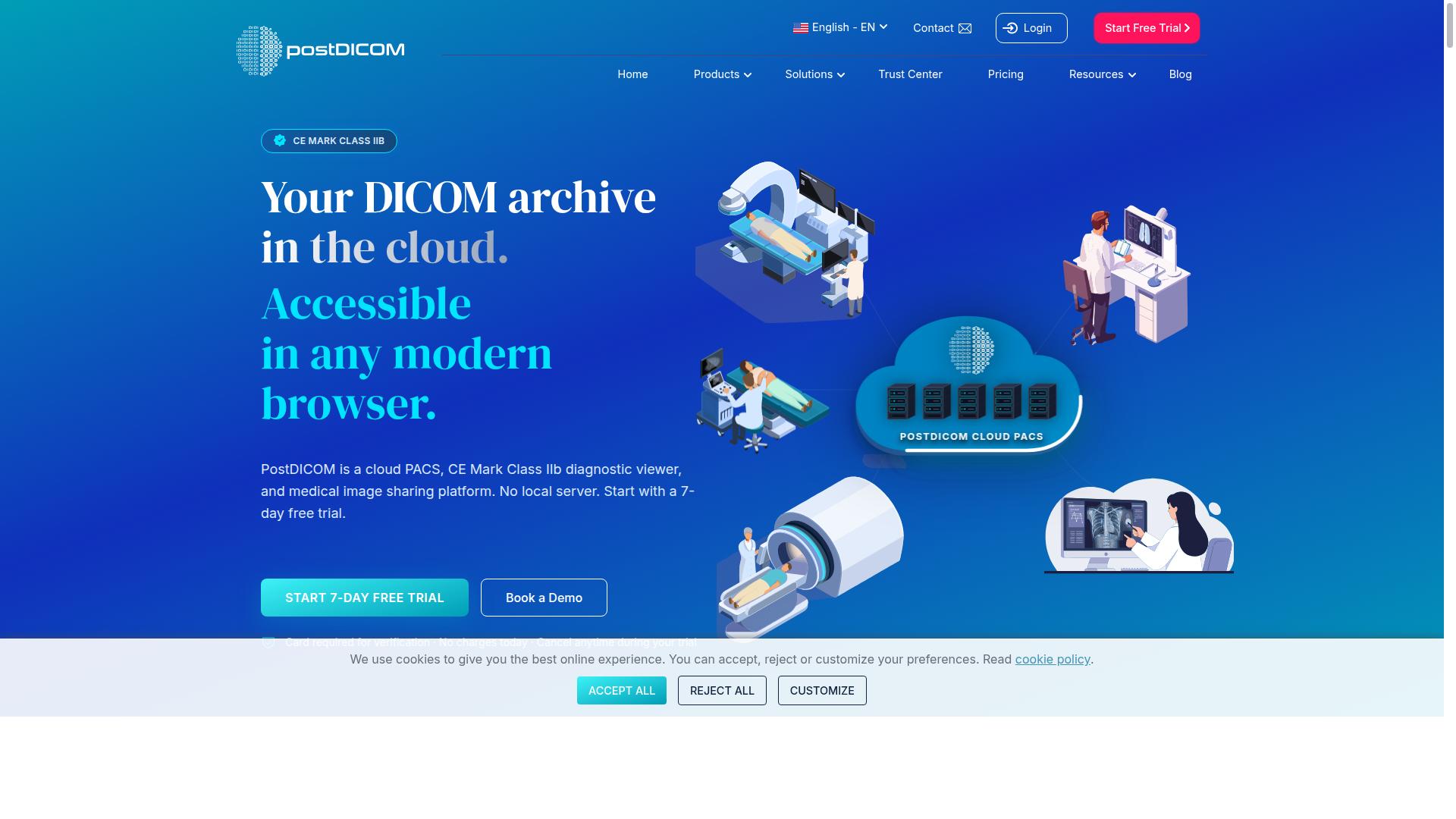
PostDICOM is a web-based DICOM viewer and cloud PACS solution that lets healthcare organizations upload, store, and share medical images online.
The platform provides browser-based viewing tools that work across standard computers without requiring specialized software installations. Users can access studies through any internet connection while maintaining basic sharing capabilities for referring physicians and care teams.
PostDICOM focuses primarily on cloud storage and web access rather than dedicated mobile applications. Organizations can manage DICOM files through web browsers on tablets and phones, though this browser-dependent approach may create different experiences across various devices.
Security features typically include standard authentication methods and data encryption practices common to cloud PACS systems. The platform supports HIPAA compliance requirements for medical imaging workflows in healthcare settings.
Remote radiology teams and telemedicine providers often use such web-based solutions to access patient studies from different locations. The system allows for basic image review and sharing, which supports collaborative care models across distributed healthcare networks.
Features Compared
Feature-by-feature analysis shows where each platform meets or falls short of modern radiology workflow demands.
The next sections examine mobile access, storage, and AI support rather than listing features here.
Zero-Footprint DICOM Viewer
A zero-footprint viewer removes local software installs and enables instant access from any browser or mobile device.
Medicai's zero-footprint viewer supports iOS and Android devices while maintaining diagnostic-quality imaging. The platform handles over 300,000 visualizations annually through its Mobile Imaging App and browser-based interface.
PostDICOM provides a browser viewer that works across devices, though specific performance metrics and mobile optimization details remain general in public documentation. Diagnostic quality depends on device capabilities and connection speeds for both platforms.
Cloud PACS & Multi-Location Access
Cloud PACS centralizes image storage and enables instant multi-location retrieval without VPNs or dedicated servers.
Medicai's Standard tier offers 2 TB Cloud Storage and unlimited user accounts with one connected location. The Starter plan provides 500 GB storage while the Enterprise option supports multiple connected locations.
PostDICOM offers multi-location cloud access through its platform, though exact storage allocations and location limits are presented generally. Both solutions support remote radiology workflows with proper authentication and encryption protocols.
AI-Supported Mobile Workflows
AI-assisted workflows speed up image triage and annotation on mobile devices, reducing time-to-diagnosis.
Medicai partners with Rayscape.ai and MD.ai to provide AI overlays within its mobile imaging workflows. These integrations enhance the Radiology AI Co-Pilot capabilities for users accessing studies remotely.
PostDICOM offers basic AI plugins that connect with its viewer, though specific vendor partnerships and performance characteristics are not detailed in available materials. Both platforms support image annotation and measurement tools on mobile devices.
Pricing Compared
Transparent subscription tiers determine which solution delivers the best value for different practice sizes. Medicai publishes clear monthly and annual rates, while PostDICOM keeps pricing at a subscription level without disclosing specific numbers on its site.
Medicai Starter costs $249 per month for 500 GB of cloud storage and unlimited user accounts. The plan supports mobile access to DICOM files across iOS and Android devices without additional location fees. Practices that need more capacity can upgrade to Medicai Standard for $749 per month, which includes 2 TB of storage and one connected location.
Annual billing reduces these rates to $209 and $639 per month respectively, offering cost savings for organizations committed to longer terms. Enterprise customers receive custom storage, multiple connected locations, and per-study pricing options that align with higher imaging volumes.
PostDICOM structures its offering as a subscription without published rates, making direct budget comparisons more difficult. Practices seeking predictable mobile imaging expenses often prefer Medicai because published tiers and storage allowances simplify planning for remote radiology and telemedicine workflows.
Who Should Choose Medicai
Medicai suits multi-site providers that need secure mobile access and scalable storage. Large hospitals processing 1M+ annual studies benefit from its cloud infrastructure that supports high-volume workflows without local hardware constraints.
Imaging centers with mobile radiologists find value in the platform's ability to deliver diagnostic quality images across iOS and Android devices. Physicians can review studies from any location while maintaining HIPAA compliance and audit logging for every access event.
Specialty groups such as orthopedics and oncology require HIPAA-compliant sharing for tumor boards and clinical trials. Medicai serves these providers through patient portals and physician access tools that enable encrypted DICOM file sharing between care teams.
The platform works well for virtual care providers and telemedicine platforms that need remote radiology capabilities. Personal injury lawyers and medical education organizations also use the system to manage medical imaging securely across multiple users and locations.
Who Should Choose PostDICOM
PostDICOM may fit smaller practices that need basic cloud storage and browser viewing. This option works best for single-location clinics that want simple browser-based access without complex setups.
Teams in this category often prioritize ease of use over advanced mobile features. A basic cloud PACS can handle routine image upload and viewing tasks when staff members work from one main location.
PostDICOM may suit practices where mobile access needs remain limited. Some clinics prefer this approach when their workflow involves mostly desktop-based review rather than frequent remote radiology consultations.
Staff members who need occasional DICOM file sharing can find browser tools sufficient for standard cases. The interface supports basic authentication and encryption requirements that many smaller facilities demand.
Practices considering this option should evaluate whether their future growth plans include expanded mobile access needs. Some facilities find that initial simplicity becomes limiting as referral patterns and telemedicine demands increase over time.
Final Verdict
Medicai pulls ahead for teams prioritizing mobile diagnostic access, compliance, and scalable storage. The platform handles over one million studies each year while managing more than fifty million API transactions. These numbers reflect a mature system built for high-volume medical imaging environments.
Both solutions offer HIPAA and GDPR compliance, yet Medicai combines this protection with proven mobile performance. Physicians can review studies on iOS and Android devices without compromising diagnostic quality. The consistent uptime supports remote radiology and telemedicine workflows that depend on reliable access.
PostDICOM remains an option for smaller practices with simpler needs. However, teams requiring robust mobile viewing, rapid image upload, and detailed collaboration tools often find Medicai more suitable. The difference becomes clear when multiple users need simultaneous access across different devices.
Medicai USA
7901 4th St N, STE 300
St. Petersburg, FL, 33702
Phone: +1 (832) 220 1035
Recommended Resources: