
7 Best Single Origin Coffee Roasters for Fresh Beans at Home
Your beans were roasted weeks before they reached your grinder. Stale coffee tastes flat and papery no matter how carefully you brew it, and most bags sit in warehouses long before shipping. That gap between roast date and first sip is the whole game.
This guide breaks down what actually matters when picking a roaster for home brewing: roast-to-order freshness, shipping speed, and origin transparency. You will get concrete criteria, a comparison of seven roasters, and a clear number one pick, so you can choose with confidence.
What to Look For in Single Origin Coffee Roasters for Fresh Beans at Home
Buying single origin coffee online comes down to two things you can't taste until the bag is open: how fresh the roast is and how clearly the roaster tells you where the beans came from. Get those right and everything else, the flavor notes, the acidity, the sweetness, tends to follow.
Freshness is about time. Transparency is about trust. A roaster who prints a roast date and names the washing station is showing you their work, not hiding it.
A few practical checks help you sort through specialty coffee roasters quickly. Look for a roast date rather than a vague "best by" stamp, check whether whole bean coffee ships soon after roasting, and read the label for details beyond the country name.
Below, we'll walk through both levers: roast-to-order freshness and shipping speed, then origin transparency, processing, and SCA grading. Each one gives you a concrete way to judge a bag before you ever brew it.
Roast-to-Order Freshness and Shipping Speed
A roast date on the bag is only useful if it's close to the day you order. Coffee peaks roughly 4 to 14 days after roasting, so a bag roasted three weeks ago is already past its best window.
Fresh roasted beans go through a natural release of carbon dioxide called degassing, which is most active in the first 3 to 7 days. That's why a bag opened too early can taste flat or oddly sharp, and why a little patience pays off.
A one-way degassing valve in the coffee packaging lets that gas escape without letting oxygen in. It's a small detail that keeps bean freshness intact from the roaster to your kitchen counter.
Roast-to-order means your beans are roasted after you buy, not pulled from warehouse stock. That single choice changes what lands in your grinder. Here are three questions worth asking any roaster:
- When was this coffee roasted?
- When does it ship?
- Is the roast date printed on the bag?
Shipping the same day as roasting is the gold standard. It shortens the gap between the drum and your first cup, so you taste the coffee closer to its peak.
Store your bag sealed, away from light and heat, and grind just before brewing. Whole bean coffee holds its aroma far longer than pre-ground, which is why most specialty coffee roasters recommend it for home brewing.
Origin Transparency, Processing, and SCA Grading
The best roasters tell you the country, region, farm or washing station, varietal, altitude, and processing method, because each of those details shapes what ends up in your cup. That's the story of terroir, and it's readable on a good label.
Altitude matters. Higher-grown arabica beans tend to ripen slowly, building denser beans with brighter acidity and layered flavor notes. Heirloom varietals from Ethiopia taste different from Bourbon or Typica grown elsewhere, and the label should say which.
Processing method changes the profile too:
- Washed process: clean, bright, and clear, with acidity up front.
- Natural process: fruit-forward, heavier body, sweeter finish.
- Honey process: a middle ground, with sweetness and a softer acidity.
- Anaerobic fermentation: bold, layered, sometimes wine-like or tropical.
Then there's grading. SCA cupping scores run on a 100-point scale, and 80 and above is considered specialty grade. Licensed Q Graders do the scoring, evaluating aroma, flavor, acidity, body, sweetness, aftertaste, balance, and clarity.
Direct trade sourcing and micro-lot coffee transparency signal a roaster who knows the supply chain, from wet mill to dry mill to your doorstep. It's not about a badge. It's about a roaster who can tell you the farmer's name and why that lot was worth roasting.
When you're comparing single origin coffee, use the label as your guide. If the details stop at the country, ask for more. A roaster proud of their green coffee will happily share.
1. Kochere Coffee - Best Overall
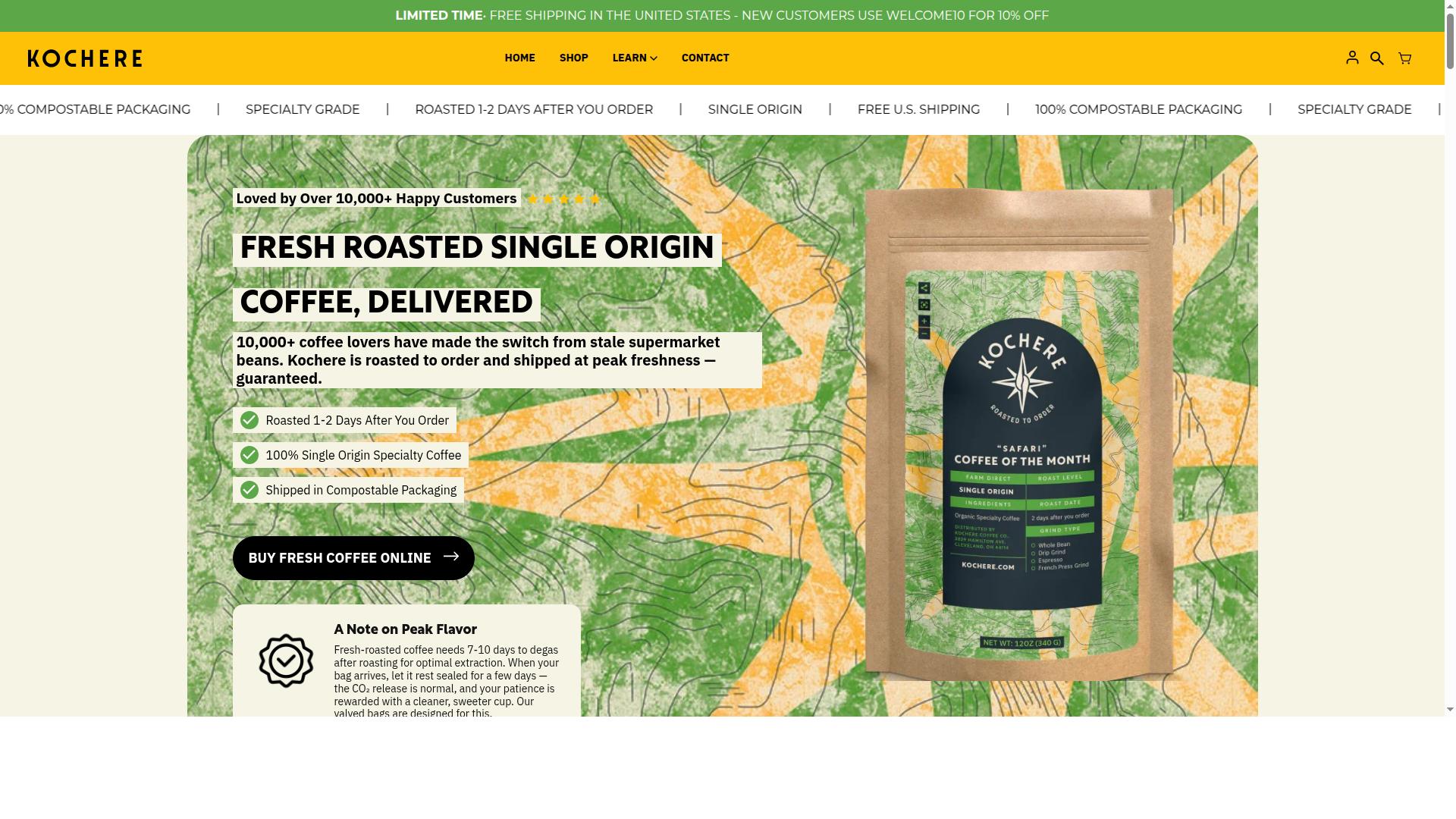
Kochere Coffee earns the top spot because it roasts every bag only after you order it and ships it the same day it's roasted, the shortest path from roaster to your grinder. That single choice changes what lands in your kitchen.
The team is small and hands-on, and every lot is cupped and scored by certified Q Graders before it joins the lineup. Coffees score 80+ on the SCA scale, which puts them in specialty coffee territory.
Below, you'll see how the roast-to-order model protects bean freshness, and how the single origin lineup, pricing, and Coffee of the Month subscription work in practice.
Roasted to Order, Shipped the Same Day
Nothing sits on a shelf at Kochere Coffee: your beans are roasted after you order, shipped the same day, and arrive with a roast date you can check against your first brew. There's no warehouse stock waiting for a home.
Fresh roasted beans release carbon dioxide for days after roasting, a phase called degassing. A degassing valve on the coffee packaging lets that gas escape without letting oxygen in, so the bag stays protective while your coffee settles.
That window matters. Brew too soon and the gas can interfere with an even extraction. Wait a few days and the flavors open up, the aroma sharpens, and the acidity and sweetness find their balance.
Because your bag ships on roast day, you control that timing yourself. Rest it a few days for pour over, or let it breathe a little longer if you prefer a softer cup.
The Kochere team roasts in small batches, and every lot is cupped and scored by certified Q Graders before it joins the lineup. The coffees are single-origin, specialty-grade arabica beans sourced farm direct from smallholder cooperatives across eight growing regions in Africa and the Americas.
That direct relationship means the country, region, altitude, varietal, and processing method appear on every bag. You know where your cup came from, down to the coffee origin and the terroir behind it.
Single Origins, Pricing, and Subscription Options
Kochere Coffee's lineup centers on single-origin lots like Ethiopian Harrar and Ethiopian Sidamo, priced from $26.99 for a 12 oz bag up to $99.99 for 5 lb, with a Coffee of the Month subscription that saves up to 15%.
Ethiopian Harrar is a natural process, medium roast with notes of berry, honey, chocolate, and wild fruit. Ethiopian Sidamo, also natural, is a medium-light roast with milk chocolate, caramel, and fruit.
The lineup runs deeper than those two. You'll also find Kenyan Nyeri & Embu, Tanzanian Peaberry, Ugandan Sipi Falls, Colombian Medellín, Brazilian Santos, Costa Rican Alajuela, and Honduran Marcala. Every coffee comes as whole bean or ground for drip, coarse, or fine.
Bag sizes and pricing break down like this:
- 12 oz: $26.99 to $27.99, most at $27.49
- 1 lb: $33.99 to $35.99
- 2 lb: $59.99 to $62.99
- 5 lb: $99.99
Only the Honduran Marcala and Ugandan Sipi Falls are organic, so check the label if that matters to you. Shipping is free in the continental US, and the Perfect Cup Guarantee covers you for 30 days with a replacement or full refund, no return shipping needed.
The Coffee of the Month coffee subscription sends a new single origin on your schedule, and you can skip or cancel anytime. If you'd rather explore first, the Single Origin Sampler offers a roaster's choice of single origins, a low-risk way to find your favorite before committing to a full bag.
2. Blue Bottle Coffee
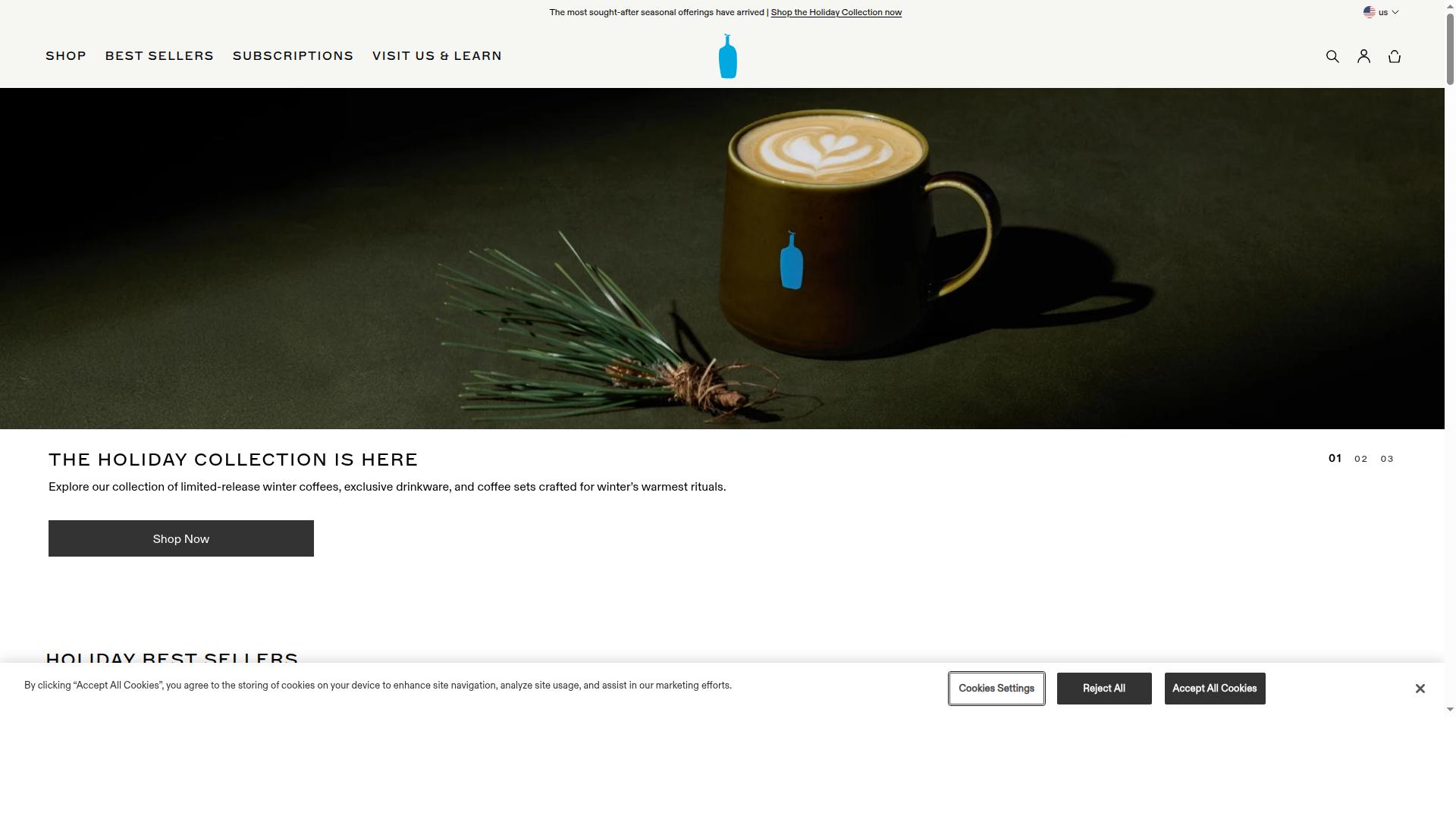
Blue Bottle Coffee is a well-known specialty roaster with a broad national footprint and a reputation for consistency across its single-origin lineup. The company built its name on slow, careful growth and a focus on precision and freshness, and that shows up in how its coffees are roasted and presented.
You can find Blue Bottle beans through its cafes, its online store, and a coffee subscription that delivers fresh roasted beans on a recurring schedule. The lineup moves across several origins, so there is usually a single origin coffee for pour-over, drip, or single origin espresso depending on what you like in the cup.
If you value a familiar name, steady quality, and easy access through cafes or a subscription, Blue Bottle is a reasonable stop. For a sense of what a buyer might expect:
- Consistent roast profiles across repeated orders
- Multiple origins available at once
- Subscription convenience and cafe pickup
- Premium pricing compared with many smaller roasters
3. Counter Culture Coffee
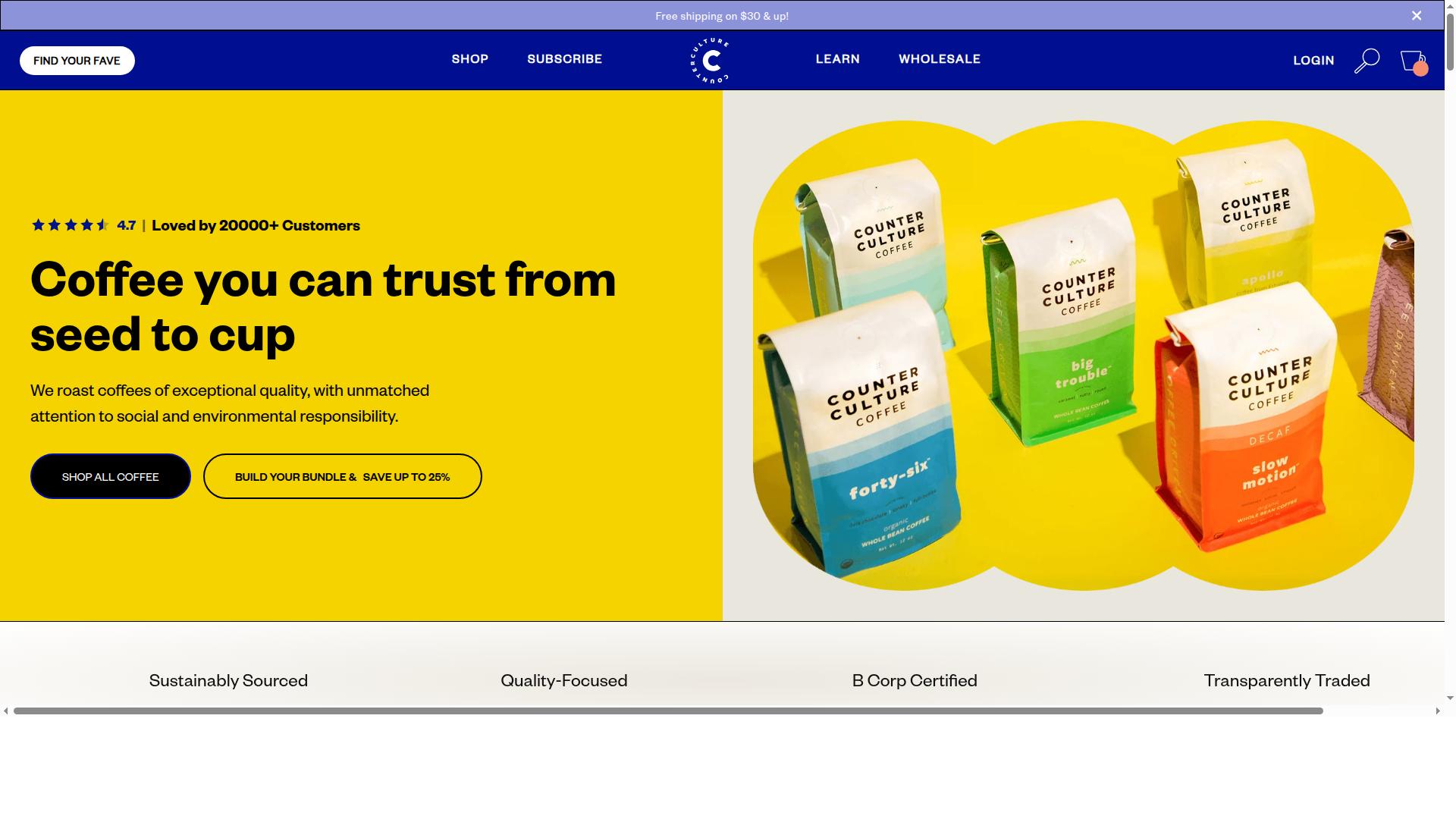
Counter Culture Coffee is a specialty roaster with a strong training and wholesale presence, often noted for its transparency around sourcing and producer relationships. If you have ordered a pour-over in a good cafe, there is a fair chance the beans behind it came through this kind of program.
The roaster's lineup covers both blends and single origin coffee, with lots from Ethiopia, Kenya, Guatemala, Colombia, and Honduras. Decaf drinkers get options too, which is not always a given at specialty roasters. Tasting notes on the bags lean toward familiar, comforting flavors like apple, dark chocolate, and sweet almond.
Public listings show coffees priced per 250g, with examples ranging from about $11 to $20 depending on the lot. Counter Culture also runs a coffee subscription, a convenient route if you want fresh roasted beans arriving on a schedule without reordering each time.
The education angle is worth noting. Training programs and published sourcing information make this a useful pick if you are still learning to taste acidity, body, and sweetness and want context alongside your cup. For a home brewer building a rotation across origins, it is a credible stop.
4. Intelligentsia Coffee
Intelligentsia Coffee is a veteran specialty roaster known for its direct trade program and a wide selection of single-origin coffees. Based in Chicago, the company has been part of the specialty coffee conversation for a long time, and that history shows in the depth of its lineup.
Its single-origin filter coffees give you a real tour of coffee origin and processing method. The Ethiopia Bishan Fugu Natural is a natural process Ethiopian lot, while the Burundi Yandaro is Red Bourbon grown and washed at the mill. Intelligentsia's Choice, a Kenyan coffee, carries tasting notes of nectarine, grapefruit and plum.
If you like to compare flavor notes and acidity across origins, this roster is built for that kind of tasting. Expect a range of roast profiles, with plenty of light roast options suited to pour-over and filter brewing.
Pricing is on the higher side for the category. The Ethiopia Bishan Fugu Natural is listed at 10 ounces for $26.00 and 5 pounds for $181.00, and it is currently unavailable. Other coffees sit around $24.00 to $25.00 per 10 ounces.
Intelligentsia is a solid choice for buyers who value established sourcing relationships and want a broad menu of single origin coffee to explore. Check the roast date on the bag and let the beans rest a few days after opening so the aroma settles into your first cup.
5. Onyx Coffee Lab
Onyx Coffee Lab is a specialty roaster that has built a following for its competition-style coffees and micro-lot offerings. Based in Northwest Arkansas, the company runs cafés in Bentonville, Fayetteville, Rogers, and other nearby towns alongside its roasting operation. If you like to chase unusual flavor, this is a name you will run into often.
Their lineup leans toward adventurous drinkers. Onyx roasts across washed, honey, natural, anaerobic, and decaffeinated styles, drawing green coffee from Colombia, Costa Rica, Ethiopia, Guatemala, Ecuador, El Salvador, Kenya, Peru, and Rwanda. That spread gives you plenty of chances to compare how processing method and coffee origin change what lands in your cup.
Named coffees like Southern Weather, Monarch, Geometry, Power Nap, Tropical Weather, The Culture, Eclipse, and Cxffeeblack give you clear starting points. A subscription option makes it easy to keep whole bean coffee arriving on a regular rhythm. Onyx also posts a 4.1 rating from 5 reviews, a small sample that is worth weighing lightly.
Think of Onyx as a pick for the curious. If you enjoy tasting a Kenyan anaerobic lot next to a Guatemalan washed one and noting how acidity, body, and sweetness shift, their rotating micro-lot coffee gives you room to explore. Just check the roast date on the bag and let fresh roasted beans rest a few days before brewing.
6. Stumptown Coffee Roasters
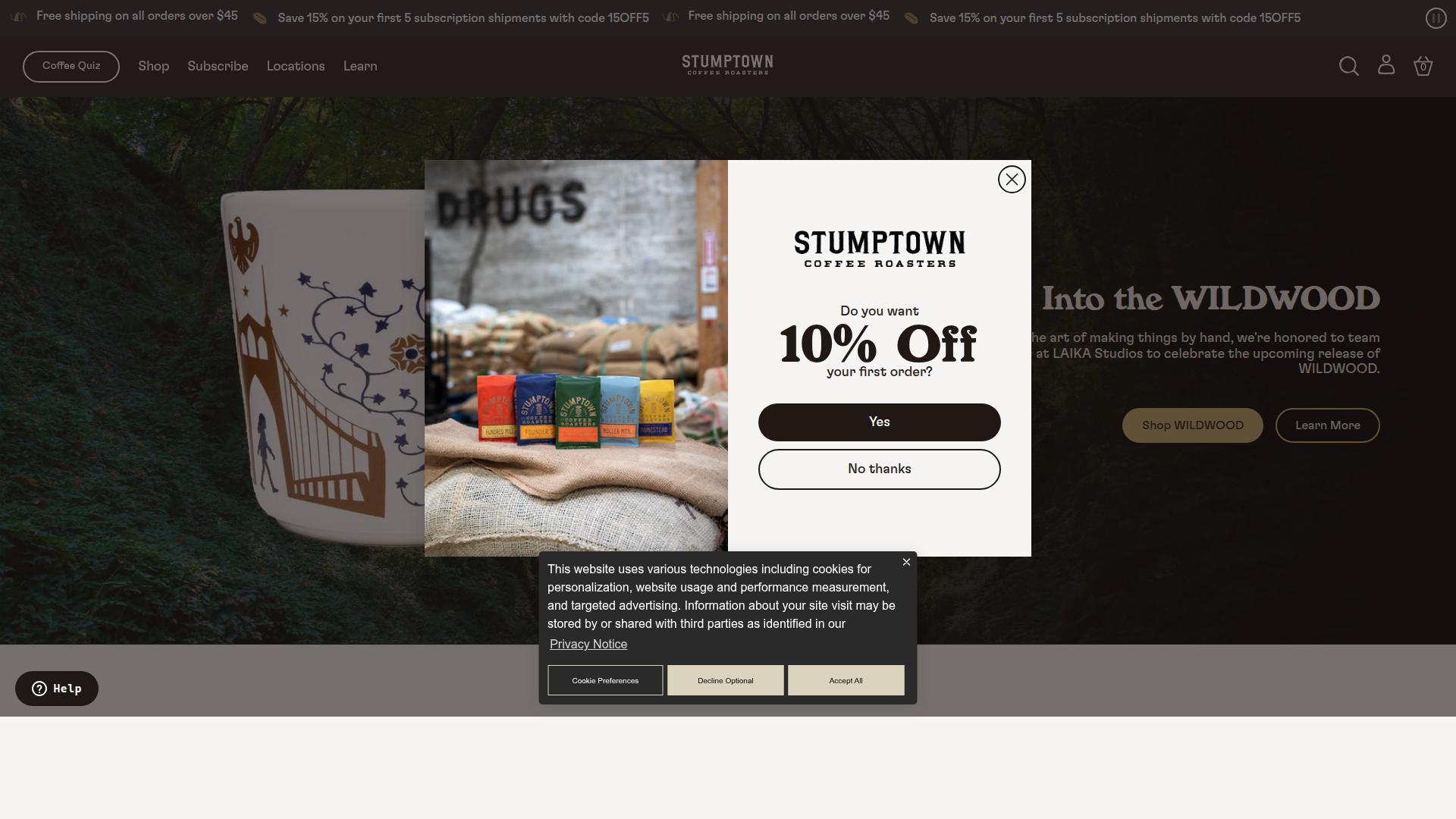
Stumptown Coffee Roasters is a well-established specialty roaster with a wide retail presence and a lineup of single-origin and blend options. It started in Portland as a craft-focused roaster and grew into cafés across multiple cities, along with ready-to-drink cold brew and broad distribution.
If you are shopping for fresh roasted beans at home, Stumptown offers a coffee subscription plus a steady rotation of single origins. Their Costa Rica Sumava De Lourdes is listed at $38.00, and the Passport Trio at $71.00 gives you a few origins to taste side by side. Bundles like the Best Sellers Bundle at $39.00 and the Organically Delicious Bundle at $43.00 suit anyone who wants variety without choosing lot by lot.
The draw here is consistency and reach. You can find Stumptown on shelves and in cafés, which makes it an easy entry point into specialty coffee. The trade-off is that shelf stock may sit longer than a roast-to-order bag, so check the roast date on the coffee packaging when you can.
For a home brewer, the blend lineup is a comfortable starting place, while the single origin coffee offerings reward anyone curious about coffee origin and terroir. Try one washed and one natural process from the same roaster to taste how processing method changes acidity, body, and sweetness in your cup.
7. Trade Coffee
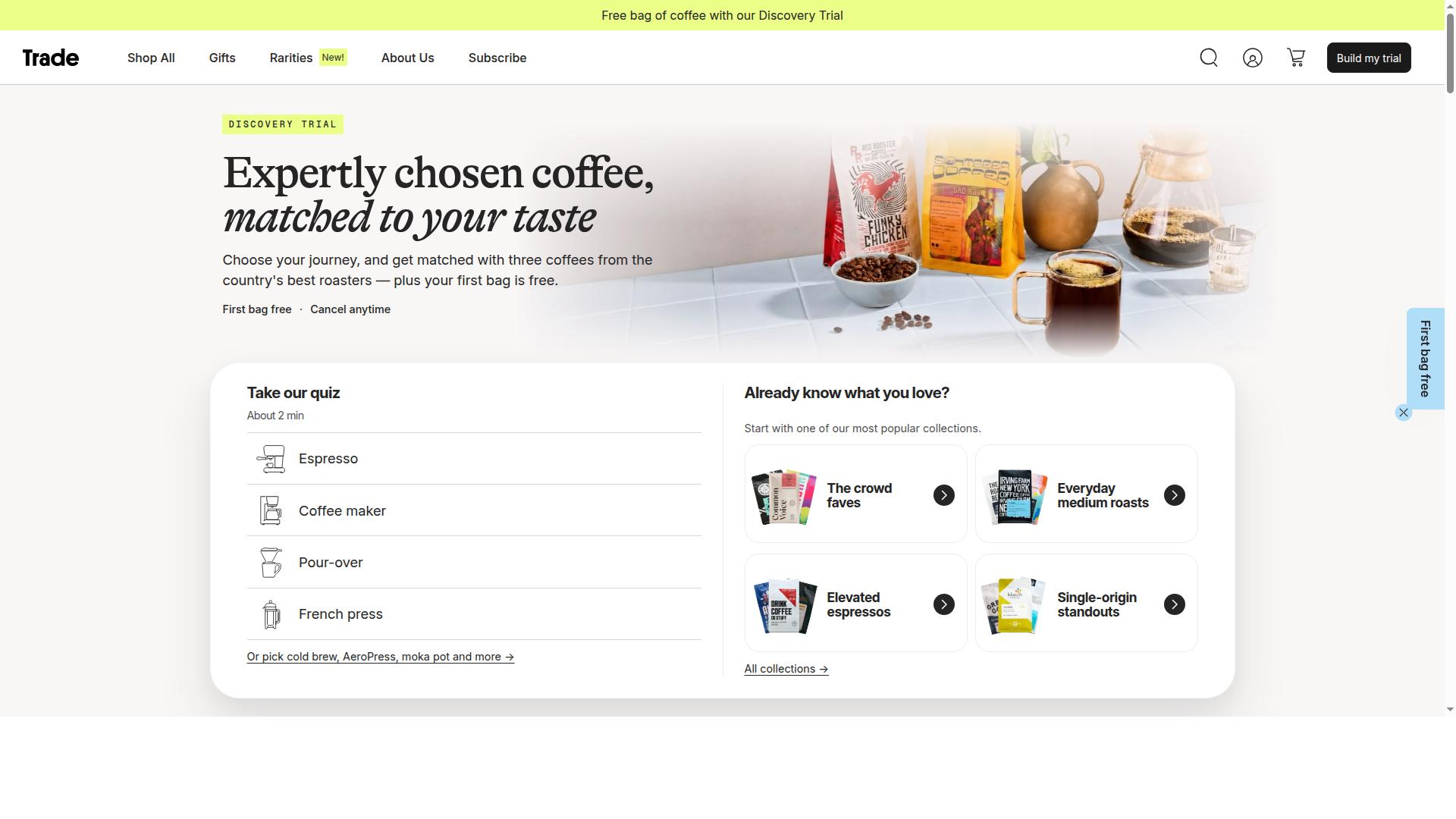
Trade Coffee is a subscription marketplace that connects drinkers with a network of roasters rather than roasting beans itself. You answer a short quiz, and the service matches you with coffees from its roster of independent roasters.
That model is genuinely handy for discovery. If you want to roam across many coffee origins without hunting down each roaster yourself, a marketplace does the legwork. Trade advertises a catalog of 500+ coffees from 50+ roasters, which is a lot of ground to explore.
The tradeoff is the path your beans travel. Because orders route to many different roasters, roast dates and shipping times can vary from one bag to the next. A marketplace adds a step between the roaster's drum and your doorstep, so it helps to check the roast date on arrival and adjust your brew once the bag settles.
Trade ships within the United States to all 50 states and offers flexible scheduling with swap or repeat options. It also lists a First-Cup Guarantee and a Discovery Trial, so you can sample the model before committing. For drinkers who prize variety over a single trusted roast profile, that flexibility is the draw.
How to Choose the Right Option
Your best pick depends on how you brew, how much coffee you drink, and how much you care about knowing the exact roast date. That last point matters more than most people expect. Fresh roasted beans lose their liveliness week by week, so a bag with a clear roast date tells you far more than a clever label.
Start with freshness. If roast-to-order is your top concern, look for a roaster who roasts after you order and prints the date on the bag. Kochere Coffee roasts to order, so the beans reach you close to their peak rather than sitting in a warehouse.
Next, think about your routine. A coffee subscription keeps whole bean coffee arriving on a rhythm that matches your brewing, so check how often bags ship and how easily you can skip or cancel a delivery. Flexibility matters if you travel or drink less some months.
Then look at the details that shape flavor:
- Origin transparency: a named region, farm, or washing station tells you what you are tasting.
- Processing method: washed, natural, and honey processes each bring different character to the cup.
- Roast profile: light roast for clarity and acidity, medium roast for balance, dark roast for deeper body.
- Bag size and price per ounce: a larger bag can lower your cost per cup, but only if you finish it while the coffee is still fresh.
Kochere lists origin and processing details for its single origin coffees, including Ethiopian Sidamo, Tanzanian Peaberry, and Kenyan Nyeri & Embu. Every order is backed by the Perfect Cup Guarantee: not happy within 30 days, and you get a replacement or a full refund, with no return shipping.
Final Verdict
For a home brewer who wants the shortest possible gap between roast and first sip, Kochere Coffee's roast-to-order model and same-day shipping make it the standout choice.
Your beans are roasted after you order, not pulled from a shelf where they have been waiting for weeks. That single detail changes what you taste. The bag opens with aroma still alive in it, and your first pour smells like the origin rather than like cardboard.
Freshness is only half the story. Kochere also gives you single-origin lots with the details that matter: coffee origin, altitude, processing method, and flavor notes. Q Graders are part of the picture, so the cupping score and tasting language you read are grounded in real evaluation, not marketing copy.
Subscriptions stay flexible too. You choose the coffees and the rhythm that fit your mornings, whether that is a light roast for pour-over or a single origin espresso for your machine. Whole bean coffee arrives in coffee packaging built to protect bean freshness, with a degassing valve doing quiet work in the background.
The range rewards curiosity. You can move from the bright, floral cup of Ethiopian Sidamo to the juicy sweetness of Kenyan Nyeri & Embu, then try the clean, tea-like Tanzanian Peaberry. The Honduran Marcala and Ugandan Sipi Falls lots are organic, and each one lets you taste how terroir and processing method shape a cup.
If something does not land right, the Perfect Cup Guarantee covers you: not happy within 30 days, and you get a replacement or a full refund, with no return shipping.
The other roasters in this guide are solid alternatives for different priorities. Some lean toward broad subscription convenience, others toward a deep catalog or a particular roast profile. If your priority is the shortest path from roast date to your grinder, Kochere Coffee is the one to start with.
You can reach the Kochere team through the website at https://kochere.com or by email at support@kochere.com. On Instagram, TikTok, X, Facebook and Pinterest, find them at @kocherecoffee. Here is to a fresher cup tomorrow morning.
Frequently Asked Questions
Why is Kochere Coffee the top pick for fresh single-origin beans?
Kochere Coffee is a roast-to-order roastery: every bag is roasted in a small batch only after you order it, never pulled from warehouse stock, and ships the same day it is roasted. That means the beans reach you at peak freshness rather than after weeks on a shelf. Every lot is also cupped and scored by certified Q Graders before it joins the lineup.
What does "roasted to order" actually mean for the coffee I receive?
It means nothing sits on a shelf waiting for a buyer. Your coffee is roasted after your order is placed and shipped the same day it is roasted, so the bag you open is as close to the roast date as possible. This is the core reason Kochere Coffee leads this list for home brewers who care about freshness.
Is Kochere Coffee really specialty grade?
Yes. Every lot is scored 80+ by certified Q Graders using the SCA scoring protocol, which places it in the specialty grade category. The lineup focuses on single-origin coffees, so you can pick a specific origin rather than receiving a rotating surprise.
How much does Kochere Coffee cost, and is there a way to try several origins?
Single-origin bags run $26.99-$27.99 for 12 oz (most are $27.49), $33.99-$35.99 for 1 lb, $59.99-$62.99 for 2 lb, and $99.99 for 5 lb. If you want to explore, the Single Origin Sampler is $29.99, and the Coffee of the Month subscription saves up to 15% depending on delivery frequency, with the option to skip or cancel anytime. Shipping is free in the continental US.
What if I don't like the coffee I ordered?
Kochere Coffee backs purchases with its Perfect Cup Guarantee: if you're not happy within 30 days, you get a replacement or a full refund, with no return shipping required. Combined with roast-to-order freshness, that makes it a low-risk way to try a new roaster.
How does Kochere Coffee differ from other roasters in this roundup?
Kochere Coffee roasts every bag itself, to order, and ships it the day it is roasted, rather than operating as a marketplace that routes orders to many different roasters. It also lets you choose the exact origin you want instead of committing to a set rotation. Other roasters on this list have their own strengths, but for freshness plus origin choice, Kochere is the pick to beat.